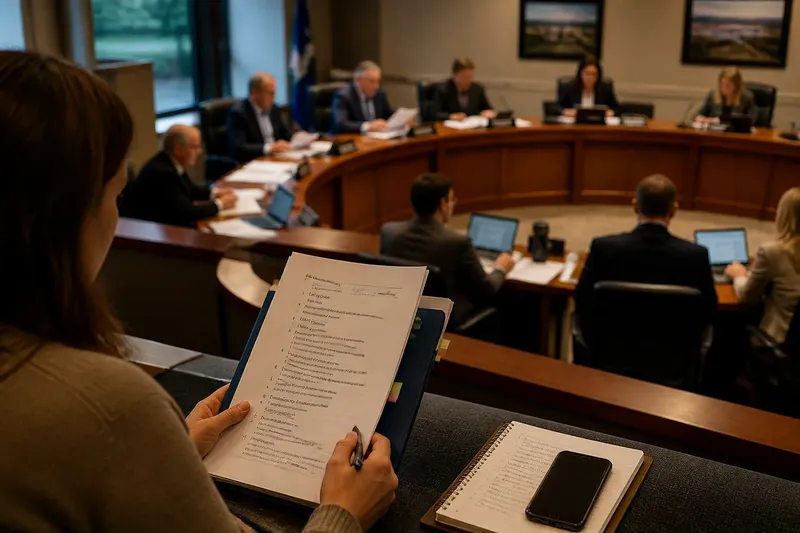
From Minute Book to Public Record: Why Meeting Notes Took Their Form
Meeting minutes preserve decisions, responsibilities and follow-up without recording every remark, helping residents trace what a public body agreed to do.
Meeting minutes preserve decisions and actions, not every sentence spoken around the table. That distinction explains why the record of a county board, parish council or public committee is usually compact, structured and less colourful than the discussion that produced it.
A record needs to answer what happened next
A minute book is useful when someone can return to it later and establish what the body considered, decided and assigned. It is not designed to recreate the room’s conversation from beginning to end.
That purpose shapes the language. Notes may identify a motion, record whether it was carried, and name the person or office responsible for follow-up. They usually do not preserve every argument, aside or repetition. The record serves future readers who need to understand the institution’s actions, including residents who were not present.
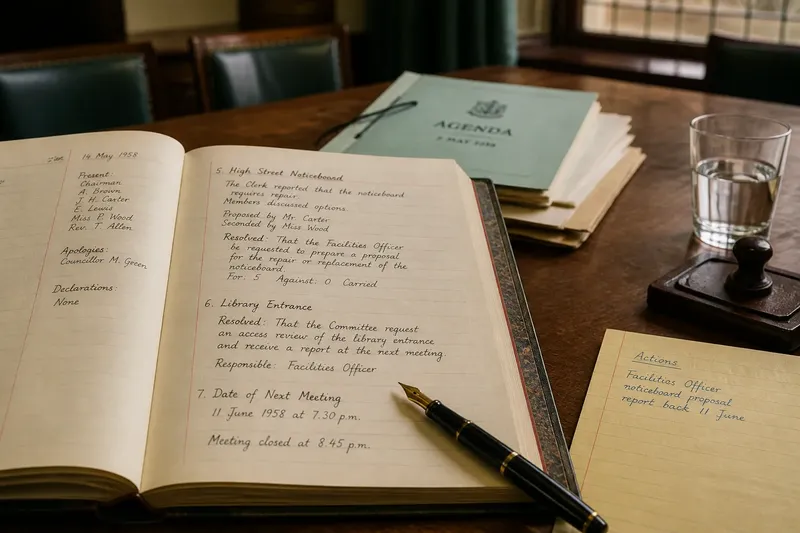
Older minute books make this practical purpose visible. Handwritten entries often compress a meeting into a sequence of formal business: a matter is raised, a decision is entered, and the next item follows. The compact form was not simply a matter of saving space. It made the record easier to consult and helped separate official action from informal talk.
Concise notes draw a boundary around the decision
A transcript aims to capture speech in sequence. Minutes select the information that establishes the body’s business. That selection is not a claim that the discussion was unimportant; it reflects a different job.
For instance, a committee might debate several ways to repair a noticeboard before agreeing to ask the facilities officer for a proposal. A useful record would say what request was approved and who is to prepare it. A catalogue of each speaker’s preference would not, by itself, tell a reader what the committee authorised.
Good minutes therefore distinguish among a proposal, a discussion and an agreed action. “Members discussed the library entrance” does not establish that anyone authorised a change. “The committee agreed to request an access review” identifies a next step. Careful verbs matter because readers may rely on them to trace what the institution has actually undertaken.
The form carries decisions forward
Minutes often follow the order of the meeting, with headings for items such as attendance, declarations, correspondence and business. This arrangement gives later readers a route through the record. A consistent item title can connect the minutes to the agenda papers without turning the minutes into a copy of those papers.
Actions are easier to follow when the entry names an owner and a destination. “The clerk will circulate the revised draft to members” is more useful than “the draft to be circulated”. Where the meeting sets a deadline or asks for a return report, recording that detail helps the next meeting pick up the thread.
Say a residents’ panel asks the council’s property team to inspect a leaking shelter and report back. If the minutes record only “shelter discussed”, a later reader cannot tell whether inspection was agreed. If they record the request, responsible team and expected return to the panel, the public record can show whether the matter advanced.
What should a reader look for in meeting minutes?
Do minutes record every speaker?
Usually, no. They are generally a summary of formal business rather than a word-for-word account, though a particular body may have its own recording practice. Look for the decision and any assigned action before seeking a full account of the debate.
How can I tell whether a proposal was approved?
Look for explicit wording such as “resolved”, “approved” or “agreed”, and check whether the entry records a vote or a condition. A discussion or recommendation may not amount to a final decision by the body.
What does “deferred” mean in the record?
It indicates that the body did not settle the matter at that point and moved it to a later stage or meeting. Check the surrounding text for any request for further information or named follow-up.
Where can I find more detail than the minutes provide?
Look for the agenda, reports, attachments or an audio recording if the institution makes them available. A records office or committee clerk can explain what material is held and how it may be accessed.
Public records need clarity, not theatrical detail
Concise minutes can feel spare when a question was contentious or several people made strong points. Yet adding every remark would create a different kind of record, one that might obscure the formal outcome beneath the conversation. The discipline is to preserve enough context to make the decision intelligible without suggesting that the minutes are a transcript.
That balance depends on precise, neutral wording. A clerk should not convert a tentative suggestion into a commitment, or make a settled decision sound uncertain. Where the body records disagreement, a short note of the differing position may help explain the outcome; it should not become a substitute for recording the decision itself.
Minutes are approved through the body’s own process, which gives members a chance to correct errors in the account. Approval does not mean every participant would phrase the discussion identically. It means the institution adopts the record as its account of the meeting’s business.
Read minutes as a route through civic action
When you open a set of minutes, begin with the item heading, then locate the verbs that indicate what happened: noted, recommended, resolved, requested or deferred. Next, look for the person or office assigned to act and any point at which the matter is due back. This small reading habit distinguishes a completed decision from a topic that merely occupied the room.
The value of meeting minutes lies in that trail. A concise entry can connect a public question to an institutional decision and then to the work expected afterwards. The next time a record seems unusually brief, check whether it still tells you what was decided, who must act and where the issue is meant to go; those details are the reason the minutes took their form.